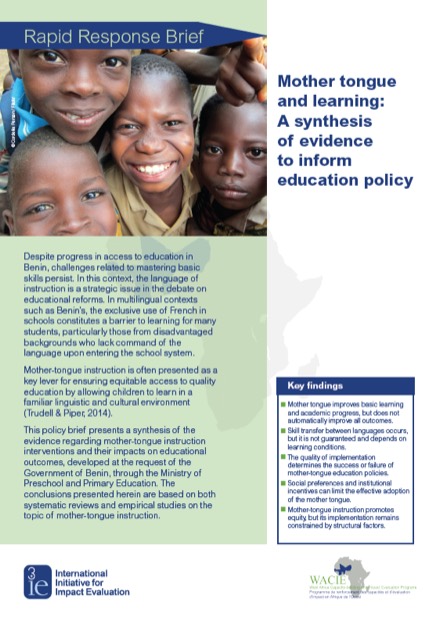
This brief synthesises 38 impact evaluations and 4 systematic reviews covering mother-tongue and bilingual instruction in 19 low- and middle-income countries. Teaching children first in a language they already speak raises early reading scores and keeps them in school, with the largest effects where teachers were retrained in the language of instruction and where readers and workbooks were available in that language. Where materials were translated but teachers were not retrained, the gains largely disappeared. The evidence is thinner on what happens at the point of transition to a national or international language, which is where most programmes place that transition between grades three and five. Three of the 38 studies follow children beyond the transition year, and none follows them to the end of primary school, so the long-run effect on literacy remains unmeasured. The brief closes with four questions a ministry should be able to answer before committing to a language policy, and names the two evaluations currently in the field that will report against them.